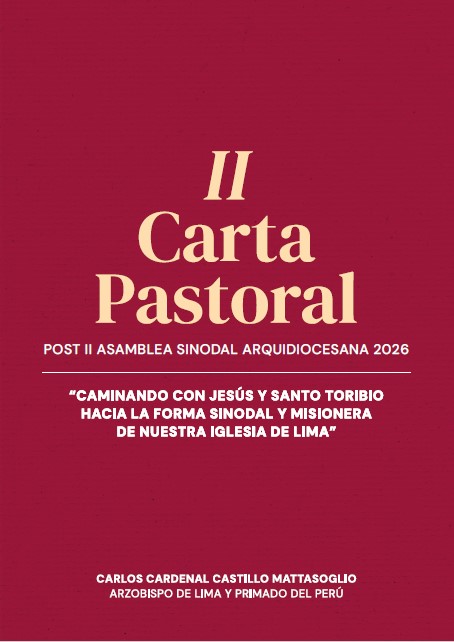
A fine example of how synodality can also inspire the episcopal magisterium of a diocese comes to us from the Archdiocese of Lima (Peru), where the local archbishop, Cardinal Carlos Castillo Mattasoglio, has just published his ‘Second Pastoral Letter’, the fruit of the Second Archdiocesan Synodal Assembly held last January.
Following a listening process held in the various parishes across the archdiocese, which lasted almost six months, the more than 950 assembly members gathered at San Agustín College on 6, 7 and 8 January 2026 conveyed the sentiments of the People of God, culminating in a number of interesting proposals. The outcomes of these discussions, which took place as ‘conversation in the Spirit’ across all the working groups, have enabled the Archbishop to listen and understand their concerns and what the Lord is asking of the Church of Lima.
As the Archbishop writes in the introduction,
“this Second Pastoral Letter is intended to be a faithful reflection of your efforts. And throughout Lent and Holy Week, these questions have been close to my heart: What are our people trying to tell us? What lies behind their words, ideas, feelings, proposals, fears, hopes, complaints and corrections? What is the Lord trying to tell us through what you express? What signs of the times come to us and challenge us from the life of the People of God immersed in the world? What seeds of the Gospel can we recognise there, sown by God, which are already renewing our lives and that of the Church? How can we ensure their continued growth whilst remaining faithful to their processes? This letter seeks to join you in your attentive gaze upon those seeds sown by the Lord, so that we may continue our journey of conversion and pastoral service”.
For this reason, the document focuses first and foremost on the theme of mission, with the first chapter devoted entirely to ‘The mission that calls the Church together’.
The document then presents five concerns that emerged during the assembly’s deliberations.
Plea 1. The plea to be heard, welcomed and accompanied: reaching out to our brothers and sisters who are furthest away
Plea 2. The plea for human dignity and life to be valued and defended
Plea 3. The plea for an integral approach to ecology to be adopted; and for social life, especially that of the poor, to be promoted and cared for with sensitivity and justice
Plea 4. The cry to strengthen the family and to foster intergenerational understanding for the common good
Plea 5. The cry that springs from popular faith and its many expressions, calling for our evangelisation to be in harmony with the deepest values that underpin these expressions and that drive appropriate formation.
The following sets out the seven proposals conceived as responses to the challenges (that is, the requests) that have arisen.
First proposal: A better assessment of the various problems and realities within each parish and across the archdiocese
Second proposal: A more comprehensive and experiential formation (in terms of content, structure and participants) that focuses, above all, on current experiences and their comparison with the life-giving experience presented to us by the Gospel
Third proposal: Greater intra- and inter-parish twinning (“sister parishes”)
Fourth proposal: A renewed diocesan spirituality
Fifth proposal: Plans and actions aimed at better communication
Sixth proposal: A greater and more effective commitment as a Church to the sufferings and initiatives of others
Seventh proposal: Institutions and organisations to be established
-
- Ministry of Welcome and Listening
- Charity Volunteering
- Pastoral Care of Communications
- Vicariate for Formation
Finally, the document concludes with a chapter entitled ‘The new form of the Church in this new missionary phase’, in which the archbishop, quoting Pope Francis’s vision: ‘we are not in an era of change but in a change of era’, urges his faithful to build a new model of the Church.
“It has fallen to us to proclaim the Gospel in a world in ruins. We are also called to bear Christian witness that leaves an indelible sign of hope from the God who loves us without measure; who made his dwelling among us; and who accepted the cross so as to set, as a beacon of guidance and hope, the forgiveness and peace of God, who is Father and not executioner".
