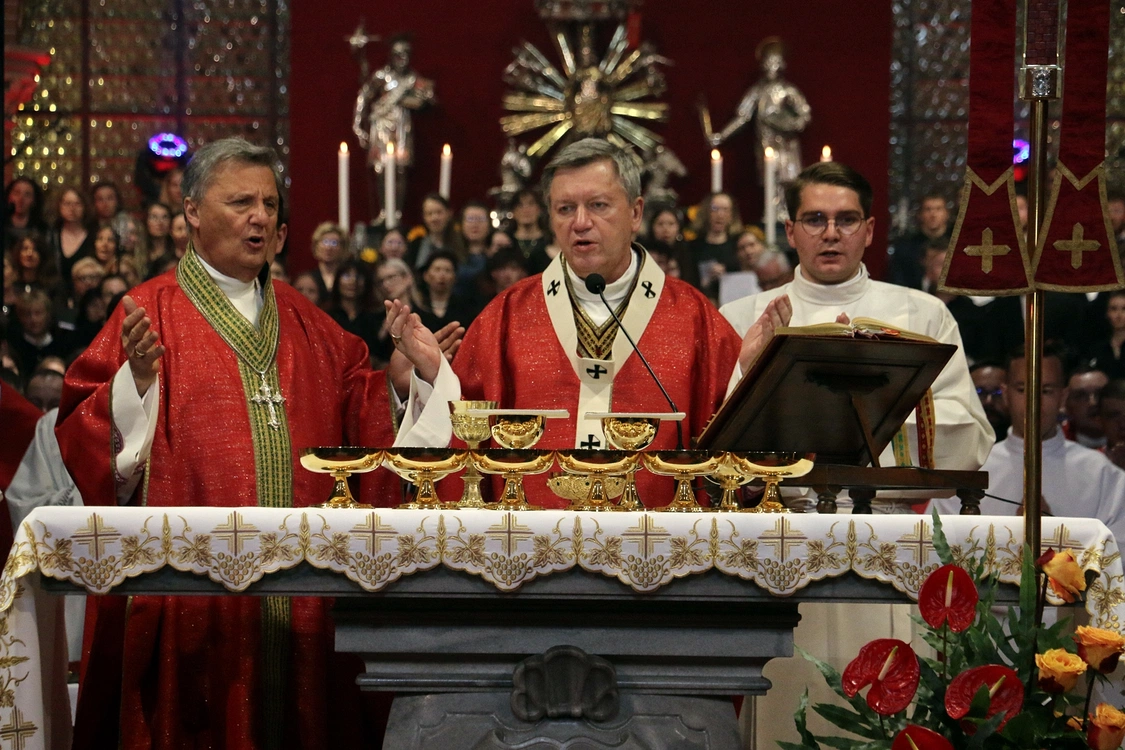
Below is the homily delivered by Archbishop Józef Kupny on the occasion of the closing of the Second Synod of the Archdiocese of Wrocław – 24 May 2026
----
Dear brothers and sisters in Christ the Lord, beloved brothers in the episcopal and priestly ministry, led by Cardinal Mario Grech, Secretary General of the Synod, and our guest of honour, all persons of consecrated life,
Dear delegates and participants in the Synod of the Archdiocese of Wrocław!
We stand before God today at a special moment, at the end of the synodal journey, which has been a time of listening, discerning and searching together for ways forward for the Church of Wrocław. We did not want to bend God's will to ours, but in prayer and in adoration of the Blessed Sacrament, we asked the Lord to enlighten our hearts with the power of his life-giving Spirit, so that we would know how to discern and do his will. Inspired by the call of Pope Francis, who called the whole Universal Church to Synod on 10 October 2021, we sought to be a Church of listening to the word of God and the Holy Spirit. However, we must be aware that today's celebration of the end of the diocesan synod is not the end of the synodal journey, but the moment of transition to the implementation phase, which will take many years and, we believe, will permanently change the face of our Church community. In this context, we are immensely grateful to the Church for the gift of today's Liturgy of the Word, for it leads us into the very heart of the mystery of the Church, into the Upper Room, into Pentecost, into the community that is born of the Spirit.
We have just listened to the words from the Acts of the Apostles, from the First Letter to the Corinthians and the Gospel written by St John of God. of St. John.
These three texts form a whole, showing the Church as a community that lives through the Holy Spirit and the diversity of gifts and the mission of reconciliation. Today's Gospel, on the other hand, takes us to the Upper Room. The apostles are locked in. The door is bolted. There is fear, uncertainty, perhaps even disappointment in their hearts. Is this image not close to us? The Church today is also experiencing uncertainty about the future, tensions and divisions, fear of a world that is rapidly changing and increasingly indifferent to the Gospel. And it is to such a Church that Christ comes. He doesn't wait for everything to be sorted out. He does not say: "improve first, then I will come". He comes in spite of the closed door and the first word he utters is: "Peace be unto you". This room is not without its problems. It's not the peace of mind that comes from making things easy. This is the peace that is born from the presence of Christ. And it was precisely this peace that our synod needed when differences of opinion arose, when critical voices had to be listened to and when questions without simple answers arose. If this peace was present and felt, however, it was because Christ was in our midst. We felt the breath of the Holy Spirit, the same breath that the disciples experienced when they heard Christ's voice: Receive the Holy Spirit. This was then the moment of the birth of the Church as a community sent to bear witness to the faith. Not closed in on itself, but one that is meant to go out into the world.
Dear friends, the Synod was not just a debate. He was not just analysing the problems. He was, above all, an opening to the Holy Spirit. Because without the Spirit we would only have better or worse formulated documents written according to our idea, our measure and newly created structures to serve these ideas of ours. Thanks to our openness to the Holy Spirit, throughout the Synod, we were accompanied by the profound conviction that only in the Spirit, and only in union with Him, is life, courage and unity in diversity born.
Let us pause briefly on the first reading from the Acts of the Apostles, for there the moment when the disciples cease to be afraid is captured. The Holy Spirit comes like a violent wind, a fire and a force that transforms. And suddenly those who were locked up for fear of the Jews come out, the silent begin to speak, the divided begin to understand each other. Everyone hears them 'in their own language'. This is a beautiful image of a Church that does not impose anything but communicates, that does not close itself off but goes out into the world and does not homogenise but unites. Isn't that what our synodal journey together was all about? To learn to listen to sisters and brothers, to understand and try to speak in a language that reaches the heart of the other?
St Paul, in his First Letter to the Corinthians, instructs that "Different are the gifts of grace, but the same Spirit". The Synod was a meeting place for priests and laity, consecrated persons and families, young and old, in a word, those with different experiences of the Church. And perhaps sometimes this diversity was difficult. But it is precisely this that has become riches, because the problem is not that we differ, the problem starts when we stop listening to each other, when we lock ourselves into our beliefs and treat difference as a threat. The Holy Spirit does not destroy diversity. He brings it into order and unites it. It creates, in the words of St. Paul, one body. "Ye are therefore the body of Christ," he writes. And this means that no one is superfluous, everyone is needed.
Our Synod reminded us of this truth that the Church is not 'them', the Church is 'us'. So not just: bishops, priests or consecrated persons, but every baptised person. We are all called to responsibility for the faith, for the community, for the future of the Church. And our mission is reconciliation. In a world full of division, tension and conflict, our Church wants to be a place of forgiveness, dialogue and restoration of relationships. The synod was not just to describe and diagnose contemporary problems. It was to help us become more open, able to forgive and ready to build unity.
Dear Sisters and Brothers, the conclusion of the Synod raises the question: what next? Will everything, all our effort of several years, remain recorded only in synodal documents? Will it become a way of life for the Church of Wrocław, a way of decision-making, a way of common discernment? I think we all agree that the Synod cannot be a one-off event. He is destined to become the path we will take together over the coming years. We need and want such a Church, open but also rooted in the community of the Universal Church. I thank Cardinal Mario Grech for his presence because it is a sign of our unity with Rome, with the Holy Father Leo XIV and with the whole Universal Church.
To reiterate, we need a Church that: listens to the world but does not lose its identity, is close to man but does not give up the truth, is merciful but does not trivialise good and evil. This tension is not easy. But it is in him that the Holy Spirit works.
At the end of this journey, we want to entrust our Archdiocese to the One who leads the Church. We are not alone. Christ, who entered the Upper Room despite the closed doors, also enters our communities, our parishes and, above all, our hearts today. And he says: "Peace be unto you".
Dear brothers and sisters, may this word of Christ remain in us as a source of hope and as a call to action. Let it remind us that the Church is alive with the Holy Spirit. So let us go forward together - as the Church of Wrocław, a listening, discerning, sent-out Church. Let us go with courage, knowing that the Holy Spirit does not stop working. And may we reveal to the world through our lives, our decisions and our community the truth that Christ is alive and present in the midst of his people. Amen