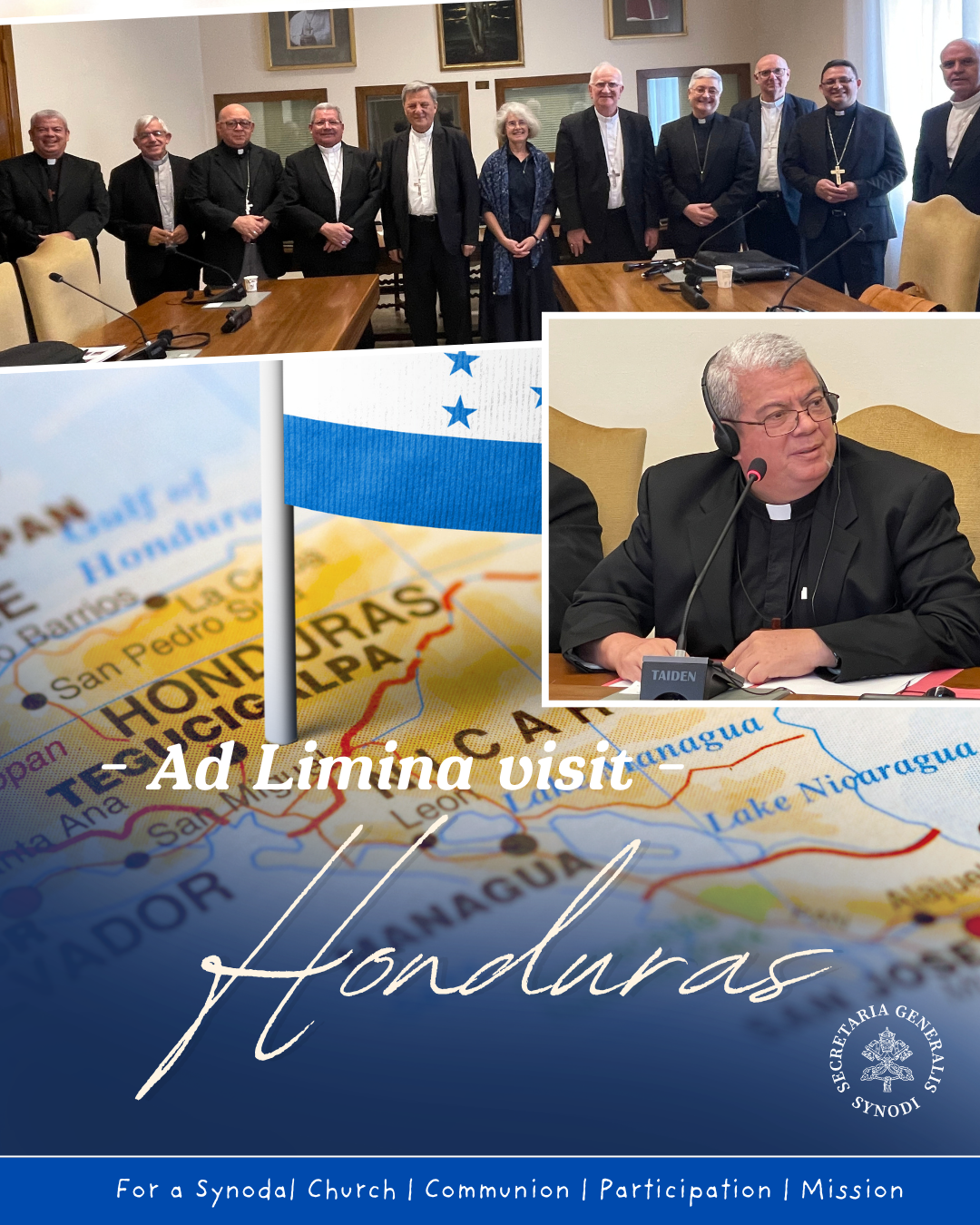
This morning, Cardinal Mario Grech and Sr Nathalie Becquart met with the bishops of Honduras on the occasion of their ad limina visit. His Excellency Mons. Jenry O. Ruiz Mora, Bishop of Trujillo, presented, on behalf of the Honduran bishops, the synodal journey and the various initiatives undertaken during this implementation phase of the synod.
Several dioceses have conducted the listening process through small synodal communities, basic ecclesial communities and other bodies, involving pastoral workers from each parish. Through the National Commission for Joint and Synodal Pastoral Care, the findings of this listening process have been integrated into the annual evangelisation campaign.
To make the synodal process its own, the Honduran Bishops’ Conference has approved a four-year plan (2023–2026). Each diocese is carrying out its own process of diocesan assemblies: genuine forums for decision-making and discernment, in which all dioceses participate alongside representatives of the various organisations, charisms, ministries and movements.
Among the main difficulties encountered are: the perception that synodality is merely a passing fad rather than a way of life for the Church; a lack of in-depth understanding of the concepts relating to synodality in certain ecclesial contexts (parishes and movements); and a clericalist mindset, coupled with a misinterpreted and highly individualistic style of leadership, which persist in some parts of the ecclesial community.
Nevertheless, the Church in Honduras has made great progress, particularly through the ministries carried out by the laity. One need only consider that, since 1966, there have been more than 20,000 ‘delegates of the Word’ who preside over the Liturgy of the Word on Sundays in the communities. Within the CEH, there has been an improvement at the administrative level, with changes particularly affecting financial reporting and evaluation. A financial report is already presented at every assembly. This has also had an impact on dioceses and parishes: “In several dioceses, a finance committee already exists in every parish and at diocesan level, whilst in others work is underway in this regard. Diocesan regulations are currently being drawn up,” reported Monsignor Ruiz Mora.
Improvements have also been noted with regard to participatory bodies. In every diocese, the diocesan and parish pastoral councils are being increasingly strengthened. At national level, the National Commission for Joint Pastoral Care ensures coordination between the various pastoral commissions.
This year, the Honduran bishops are particularly committed to the NATIONAL MISSION 2026, which aims to develop a missionary formation programme for all pastoral workers based on a Christological and missionary approach; to define the target groups and areas of focus for the mission of each local Church, giving priority to the marginalised, the estranged, families, children and young people; to implement formative and organisational processes that “involve the synodal practice of walking together, including everyone, listening to everyone and with the participation of everyone”, emphasised Bishop Ruiz Mora, adding: “We wish to promote a missionary renewal for the local Church so as to foster the transition from a pastoral approach focused on maintaining the status quo to a decidedly missionary ‘outgoing’ pastoral approach, adapted to urban, rural and digital realities.
At an ecumenical level, there have been some attempts at dialogue in areas of common interest, such as the common good, democracy, the protection of our common home, migrants and other issues. However, some evangelical groups are highly controversial and strongly attack the Church, to the extent that it is difficult to share common ground with some of them, the Honduran bishops reported.
The difficulties that persist include excessive bureaucracy and the need to improve the care shown towards the people of God in parish offices; the shift from a closed and overbearing mindset to an attitude of humility, prudence and patience; devoting more time and willingness to listening to people; the eradication of ‘caciquismo’ [a socio-political power system based on a local leader’s (known as a ‘cacique’) absolute control over the territory] amongst pastoral workers and opening up opportunities for new leadership figures to participate; taking on greater commitments and services in the social and charitable aspects of pastoral care; greater transparency with the laity in financial management.
At present, the bishops of Honduras are working on preparations for the diocesan assemblies to be held between January and April, whilst the national assembly on synodality will take place in June–July at national level in 2027.