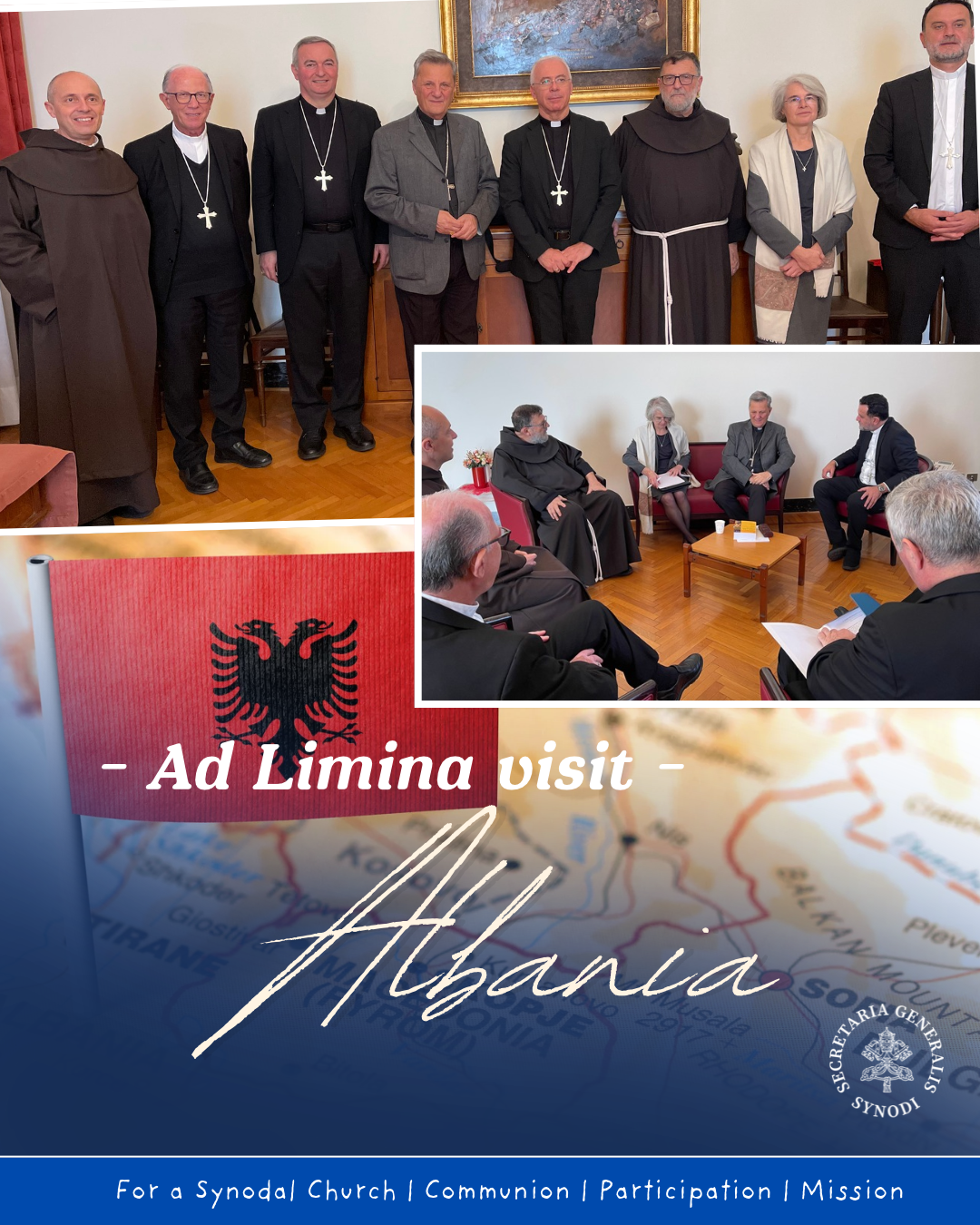
Late on the morning of Friday 30 October 2026, shortly after the announcement of the appointment of two new undersecretaries to the General Secretariat of the Synod, Cardinal Mario Grech, together with the outgoing undersecretary, Sr Nathalie Becquart, met with the Albanian bishops on the occasion of their ad limina visit.
Mgr Arjan Dodaj FdC, Metropolitan Archbishop of Tirana-Durrës and President of the Commission on the Synodal Path, outlined the synodal journey of the Church in Albania.
The synodal journey promoted by Pope Francis, and confirmed by Pope Leo XIV, has also been warmly received within the Catholic Church in Albania. One of the most significant experiences of the Synod was the rediscovery of the beauty of listening: listening to what the Spirit says to the Churches and learning to listen to one another, recognising the dignity and contribution of every baptised person. “This experience has strengthened the realisation that even a numerically small Church can offer a valuable contribution to the universal Church, by sharing the richness of its own experience of faith, its own history and its own witness,” said the Archbishop of Tirana.
The challenge remains, however, of overcoming a predominantly clerical mindset in order to promote a more conscious, responsible and practical participation by the laity. We need to create genuine spaces in which everyone can offer their gifts, take part in discernment and contribute to decision-making, in accordance with their respective vocations and responsibilities. Another challenge concerns listening to those who are furthest from the Church, to non-believers and to people belonging to other religious traditions. In this mission, the Church in Albania recognises a particular responsibility in the field of interreligious dialogue. The five traditionally recognised religious communities in the country — Muslim, Bektashi, Orthodox, Evangelical and Catholic — collaborate through the Interreligious Council.
The Albanian bishops have also recognised that new forms of language and communication cannot be ignored: “They must be understood and engaged with in accordance with Gospel wisdom, so that they may become places of encounter and proclamation. At the same time, globalisation and its negative effects can weaken community bonds and fragment human and social values. The Church is called to accompany these changes with discernment, without fear, but also without renouncing its own identity,” they stated.
A particularly significant experience on this journey was the conversation in the Spirit. “This approach has proved to be a valuable tool for fostering everyone’s participation, bringing out different perspectives and strengthening shared responsibility in the life of the Church,” concluded Archbishop Dodaj.