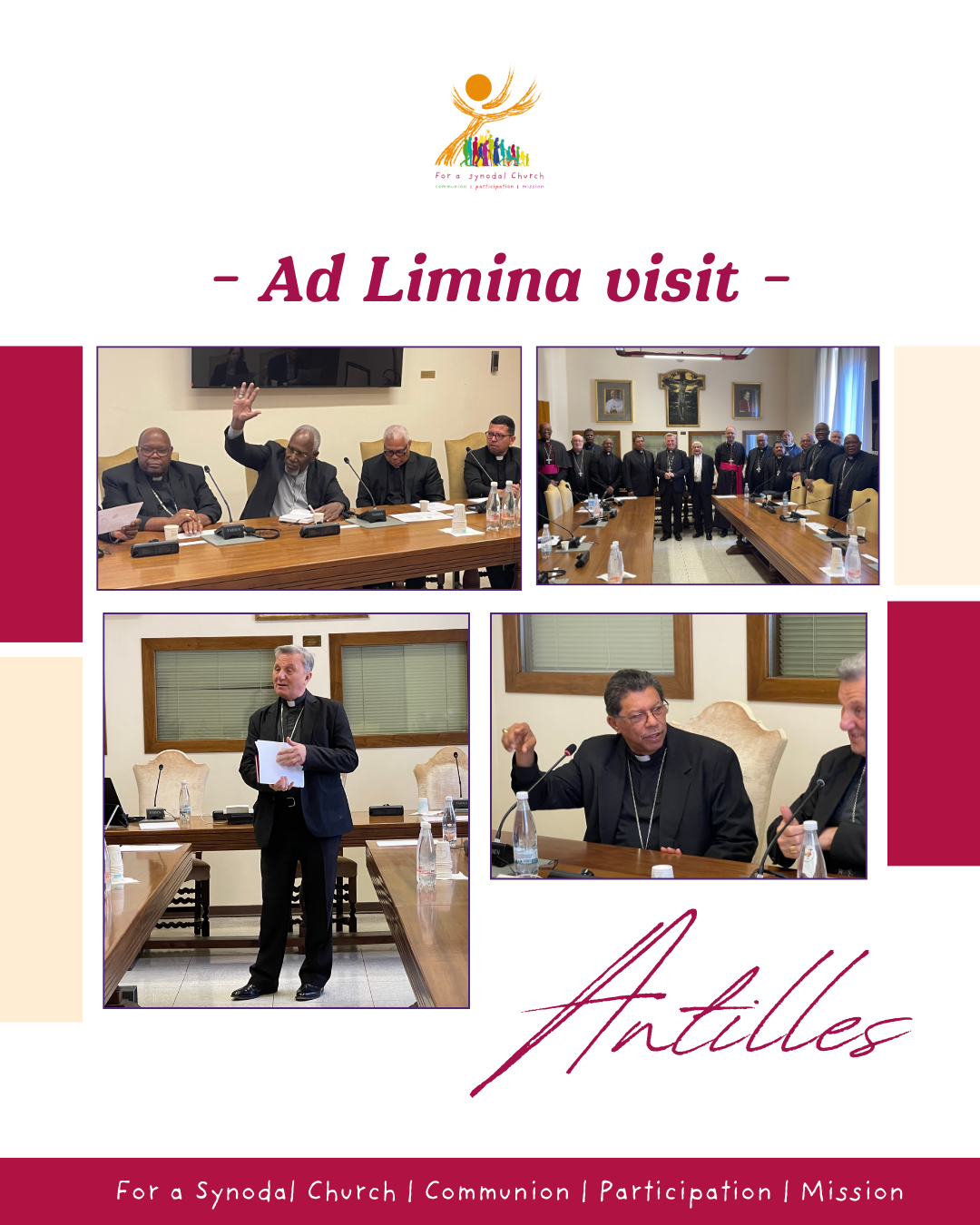
This morning, Cardinal Mario Grech met with the bishops of the Episcopal Conference of the Antilles at the headquarters of the General Secretariat of the Synod, on the occasion of their ad limina visit.
On behalf of all the bishops, Archbishop Charles Jason Gordon of Port of Spain, President of the Episcopal Conference, outlined the synodal journey during this phase of implementing the guidelines set out in the Final Document of the XVI Assembly.
Archbishop Gordon began by recalling the rich pastoral and spiritual fruits that the 2014–2021 synodal process has borne in the local Churches, such as:
-
- A growing culture of listening, marked by greater openness, respect, and willingness to relinquish personal agendas in meetings
- A deepened spirituality of trust, humility, and vulnerability, enabling participants to move from “I” to “We” through attentive listening to one another and the Spirit
- A renewed awareness that darkness, struggle, and brokenness can become spaces of grace, fostering compassion and communion
However, with deep honesty, the President of the Bishops’ Conference highlighted a number of difficulties that still remain, such as:
-
- Structured formation in synodality and Training in discernment methods
- Translating synodal formation and theological vision to concrete pastoral application and structures
- Limited structures for communal discernment
- Resistance to change and inertia in traditional practices, in particular with regard to the issue of co-responsibility and, consequently, the relationship between clergy and laity
- Insufficient leadership engagement and coordination
For this reason, local communities are increasingly adopting the practice of ‘Conversation in the Spirit’ as a method of communal discernment, including in the rethinking of pastoral meetings, where moments dedicated to prayer, discernment and mission-oriented dialogue are increasingly being integrated to encourage active listening and the participation of the faithful.
In this implementation phase, the bishops of the Antilles are working above all to ensure that synodality is understood not merely as a process but as a way of being Church, placing particular emphasis on the need f for relational pastoral leadership and accompaniment.
Although participatory bodies (pastoral councils, assemblies, etc.) exist within the dioceses, their meetings are still largely administrative or discussion-oriented, rather than spaces of spiritual discernment.
For this reason, the Conference has established a Synodal Team with one or two representatives of each of the 19 dioceses and more than half of the dioceses also have a diocesan team. Since January of 2026, we have been engaged in formation and education, particularly the spirituality of synodality. There has also been an improvement in cooperation between dioceses, despite the geographical dispersion, which does not facilitate contact.
Currently, the greatest need identified by the bishops concerns formation, both for the clergy and the laity, particularly with regard to discernment and synodal spirituality. For the bishops of the Antilles, formation is a prerequisite for implementation.