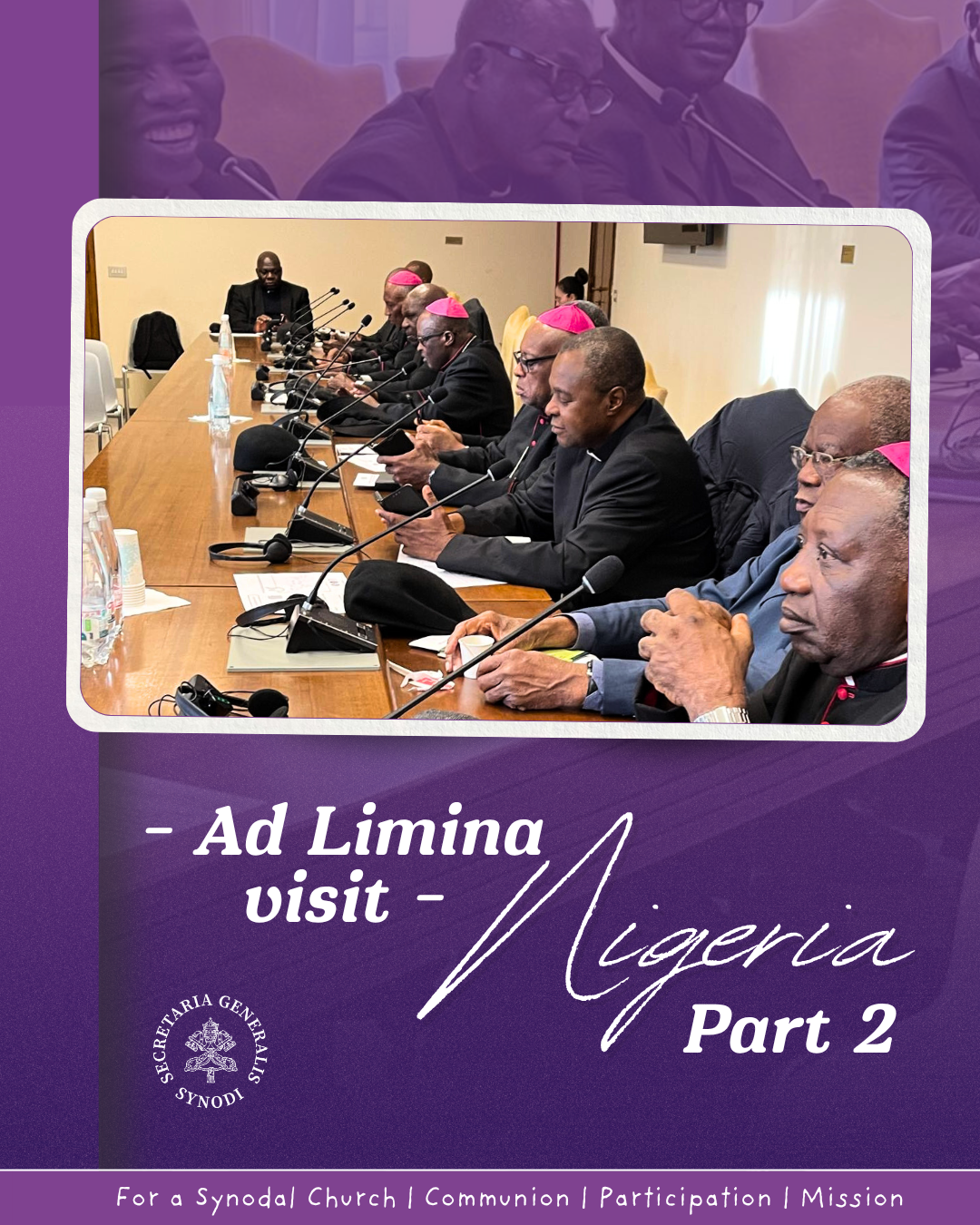
After the visit of a first group of 32 Bishops last Thursday 5 Februry, the second and last group of Bishops of Nigeria visited on the 10th March @synod_va on the occasion of their ad limina visit.
Engaged since the beginning of the synodal process, the Church in Nigeria has produced several tools and processes to enable the synodal conversion such as the production of the Sunday Lectionaries in Braille to enable visually impaired faithful to participate more fully in the liturgical proclamation of the Word. Efforts are also being intensified to incorporate sign language interpretation during liturgical celebrations and major Church programmes; a gathering of all the Bishops and their Finance Administrators for a two-day workshop on Accountability and Transparency, in the light of no. 102 of the Final Report; the development of a National Vademecum on Synodality, conceived as a practical pastoral instrument for structured implementation.
“The Vademecum seeks to translate the theological vision of synodality into clear pastoral guidelines adapted to our ecclesial and socio-cultural context”, said the President of the Bishops’ Conference. “It will clarify the relationship between episcopal authority and consultative bodies, promote accountable leadership, strengthen pastoral councils, and foster authentic lay co-responsibility rooted in baptismal dignity. It will also address synodality in seminaries, schools, youth ministry, and parish life, ensuring that listening, discernment, and shared responsibility become habitual dispositions rather than episodic events. Particular emphasis is being placed on youth participation, women’s leadership, inclusion of persons living with disabilities, and ethical governance within ecclesial institutions”.
The Bishops recognised that synodality must shape formation at every level. Seminaries are incorporating synodal theology and pastoral discernment into formation programmes. Ongoing formation for clergy emphasises collaborative leadership and responsible stewardship. In Catholic schools and higher institutions, we are exploring ways of fostering a culture of dialogue, participation, and shared responsibility among students and staff.
Finally, the CBCN has constituted a National Synodal Team to animate diocesan efforts. At the diocesan level, many bishops have retained or reconfigured their synodal committees to transition from consultation to implementation.
“In these ways”the Bishops said “the Church in Nigeria affirms that synodality requires not only structures of consultation but also concrete and visible measures to ensure that every baptised person is welcomed, heard, and empowered in the life and mission of the Church”.