
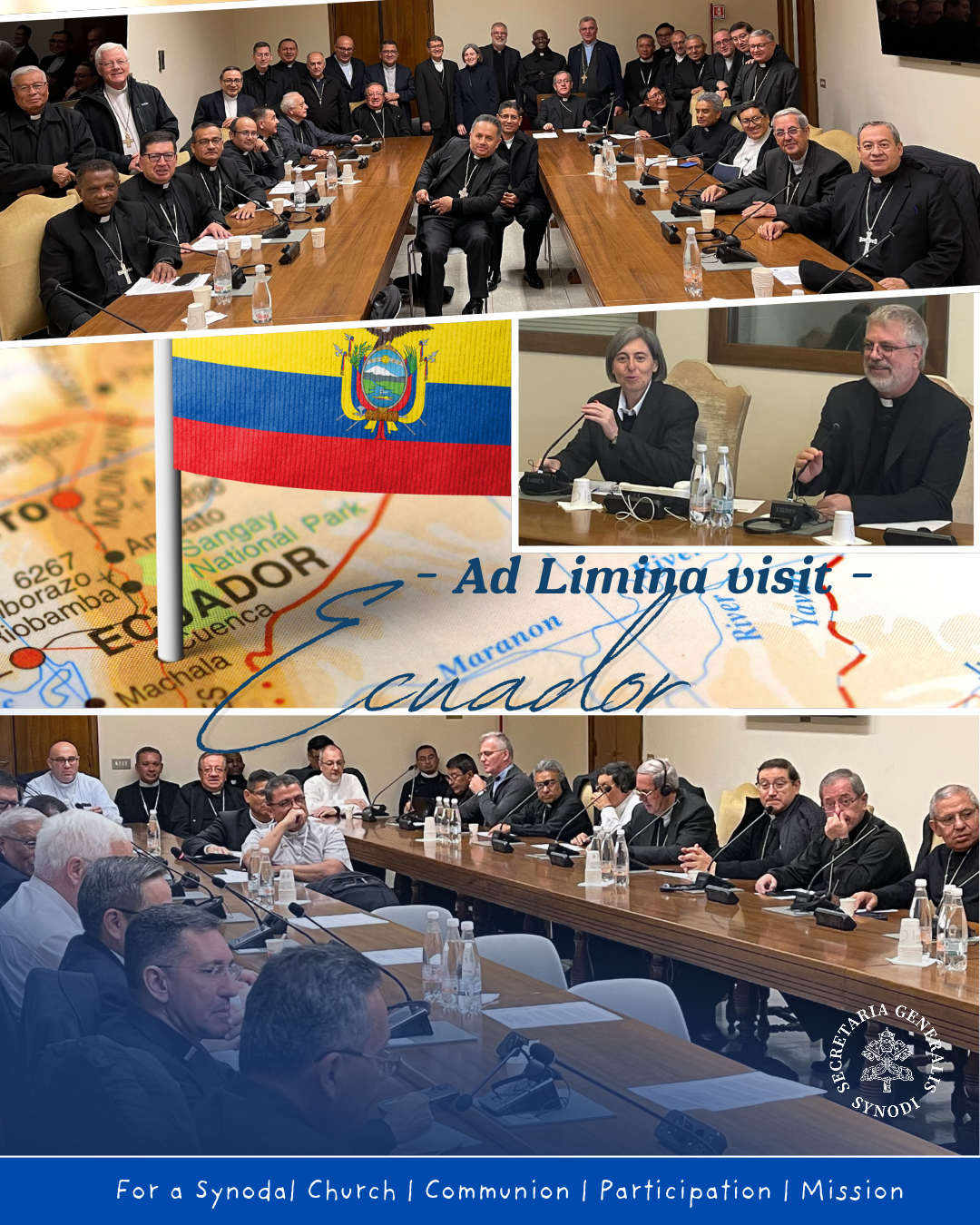
On the afternoon of Tuesday, November 17, the two undersecretaries of the General Secretariat of the Synod, Fr. Giacomo Costa, S.J., and Sr. Elena Massimi, F.M.A., met with the bishops of Ecuador on the occasion of their ad limina visit. His Eminence Cardinal Luis Gerardo Cabrera Herrera, O.F.M., Archbishop of Guayaquil and President of the Ecuadorian Episcopal Conference, presented the local Church’s journey of synodal conversion.
The bishops of Ecuador accepted the invitation to rediscover the synodal dimension of the Church as an essential element for strengthening ecclesial communion and giving new impetus to its evangelizing mission. To this end, the Episcopal Conference has promoted the acceptance and implementation of synodality through three lines of action: dissemination, formation, and implementation.
Particular attention was given to disseminating the Final Document of the 16th General Ordinary Assembly of the Synod of Bishops, ensuring that its guidelines reach the various sectors of the People of God in Ecuador, and to forming the entire People of God in the synodal style and method. Thus, meetings, seminars, and workshops were organized to deepen the practice of listening, communal discernment, and consensual and responsible decision-making, promoting conversation in the Spirit as a method of dialogue and discernment, and fostering the exchange of experiences and reflections.
In several dioceses, the diocesan pastoral councils meet monthly, and an ecclesial assembly for evaluation and planning is held annually. “The frequency of these meetings facilitates the work of the annual ecclesial assembly because it helps soften positions,” they stated. This is all the more important given that the bishops have noted the persistence of a clerical culture at the parish level—among both priests and laypersons—which often stems from a misunderstanding of the synodal nature of the Church. Therefore, alongside the need to better form priests in the synodal style, the Ecuadorian bishops emphasize the importance of the laity’s identity and mission. Becoming a missionary disciple should not be understood solely in an intra-ecclesial sense (greater participation in the life and mission of the Church, including the assumption of roles of authority), but also as directed toward the world—the secular realm—which constitutes the testing ground for the missionary disciple.
To this end, numerous catechetical, liturgical, and pastoral initiatives have been planned, aimed at progressively integrating synodal spirituality and methodology into the life and mission of the communities.
The Ecuadorian bishops reiterated that synodality is a journey of personal, communal, and pastoral conversion. “Let us strive toward a Church that strengthens the participation of all the baptized, shared responsibility in the mission, and communion in the diversity of charisms and ministries,” they concluded.