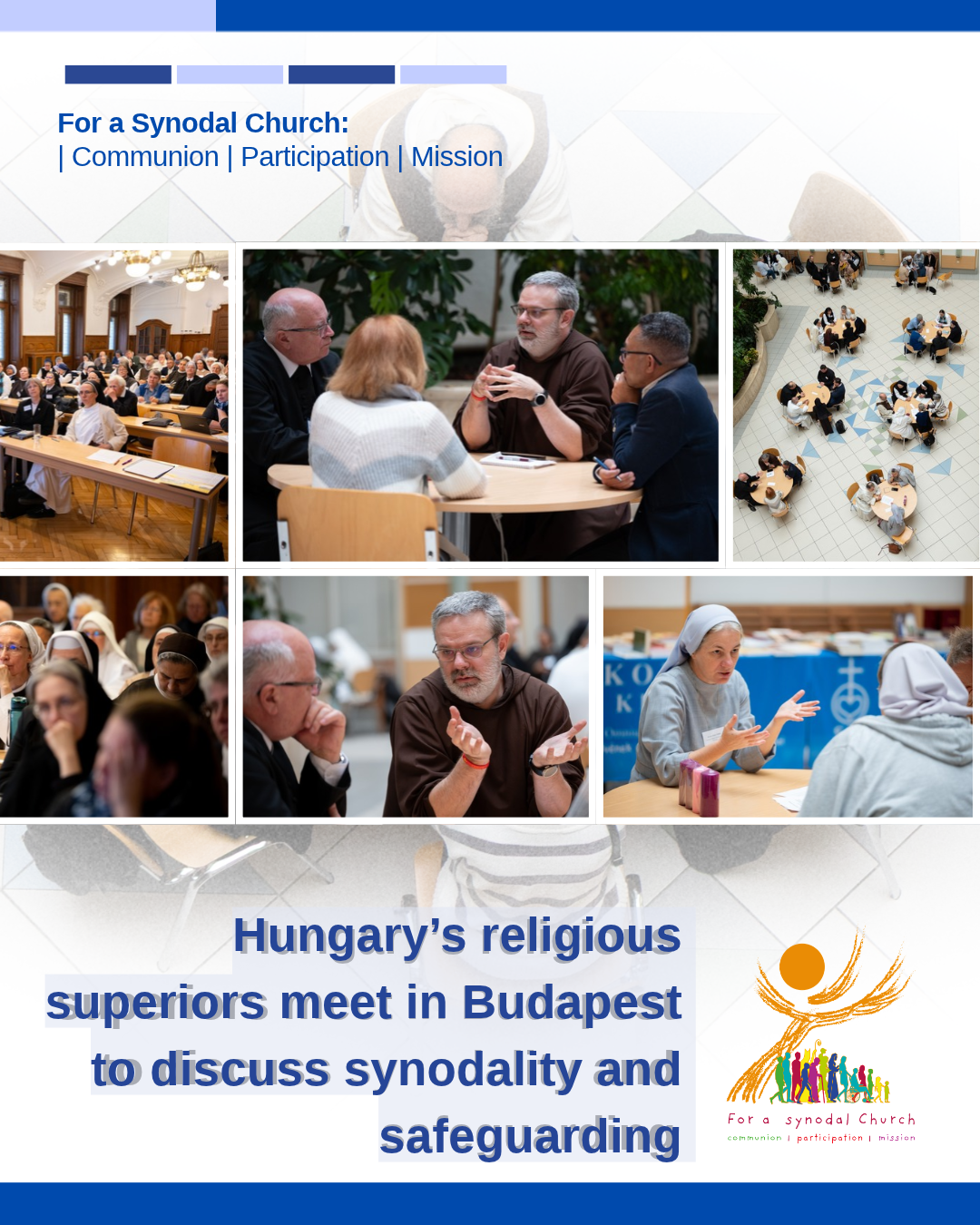
The joint plenary assembly examined how religious communities can work more closely with dioceses and what a safeguarding survey prepared for the Hungarian bishops’ ad limina visit revealed about reporting, formation and support for survivors.
The conferences of women and men religious superiors in Hungary held their joint plenary assembly at the Sapientia College of Theology in Budapest on 3 November 2026. Around 70 religious superiors gathered for the meeting, which coincided with the opening of the Hungarian bishops’ ad limina visit to Rome. The assembly brought together two questions facing religious communities: how to take a fuller part in the life and mission of the local Church, and how to make the protection of children and vulnerable persons part of everyday practice.
Making room at the table
The assembly opened with Mass in the Piarist Chapel. In his homily, Fr Viktor Zsódi SchP, Provincial Superior of the Hungarian Piarist Province and President of the Men Religious Superiors of Hungary, reflected on the parable of the great banquet and St Paul’s hymn on Christ’s self-emptying. The guests in the parable had good reasons for being busy, he observed. Religious leaders face a similar temptation when deadlines, crises and the demands of ministry leave them with little time for God.
Father Zsódi dwelt on the host’s invitation to those who could scarcely believe that a place at the table had been prepared for them. He urged religious communities to reach out with patience to people who feel unwelcome or unworthy, and to offer them a place where they can belong. He invited the superiors to bring the same humility to their own discussions, listening to one another as people called to share in the same banquet.
In a video greeting, Sr Ângela Coelho, president of the Union of European Conferences of Major Superiors (UCESM), spoke of the ties among national conferences and their place in the wider Church in Europe. Drawing on Pope Leo XIV’s encyclical Magnifica humanitas, she said that differences and tensions can become a source of creativity when people take responsibility together. She linked the reception of synodality in religious communities to their vocation to pass on the faith and bear prophetic witness amid the social and cultural changes of a secularised society.
Religious communities and the local Church
Fr Tamás Forrai SJ led the morning’s reflection on religious life and the local Church, by a video presentation. Drawing on his ministry among Hungarians in Toronto, Canada and his experience in Pécs, Hungary, he described synodal spirituality as a way for the people of God to journey together. In religious life, he said, that way of proceeding takes shape through prayer, inner conversion, listening and the exercise of each community’s charism.
Forrai presented the report of Study Group 6 of the Synod on Synodality, which examined relations among bishops, consecrated life and ecclesial associations. He explained that the report offers proposals for consideration by the competent Church authorities and that these have yet to acquire the force of law. He placed the proposals within the Synod’s implementation phase, which begins in local Churches and communities and envisages diocesan and national reviews in 2027, followed by continental and universal stages in 2028.
The proposals include appointing a vicar or episcopal delegate for consecrated life in each diocese, involving religious institutes in diocesan pastoral planning, and setting out responsibilities for ministry, formation, remuneration and the management of resources in written agreements. At national level, the report proposes regular meetings between bishops’ conferences and conferences of major superiors, joint preparation for ad limina visits, and a shared missionary project serving people on the margins. It also calls for ecclesial movements and associations to take part in diocesan planning and consultative bodies.
Father Forrai highlighted a contribution from the international unions of women and men general superiors. Drawing on Lumen gentium, they described consecrated life as a gift to the Church with its own mission of evangelisation and prophetic witness. That understanding has practical consequences for how bishops and religious institutes plan ministry together, especially where dioceses face staffing shortages. Father Forrai also asked what religious communities themselves need to change, from the way members listen and address conflict to the way a founding charism informs present-day decisions.
The video speech was followed by a work in small groups, where participants reflected on their experience of synodality and identified areas where cooperation with bishops and dioceses could deepen in a synodal way.
What the safeguarding survey found
In the afternoon, Fr Benedek Dobszay OFM presented findings from the safeguarding survey prepared as part of the religious communities’ contribution to the bishops’ ad limina visit. He explained that the visit combines pilgrimage to the tombs of the apostles and a meeting with the pope with an account of the life of the local Church and dialogue with the offices of the Holy See. The safeguarding questionnaire covered 11 thematic areas alongside a common section on the Human Dignity Strategy. Participation varied by question. The figures describe what responding communities reported about their own practices and cannot be used to estimate the prevalence of abuse.
Father Dobszay highlighted progress in safeguarding training, policies and reporting, as well as preventive measures in admission and formation. The survey also pointed to gaps in how communities handle cases, receive reports and make safeguarding information available.
Many communities lacked an established way to stay in touch with survivors, and survivor involvement in shaping safeguarding procedures was rare. Dobszay called for sustained support and for survivors’ experiences to inform how those procedures are reviewed.
He urged communities to examine leadership decisions and omissions, acknowledge harm and make reparation. He also stressed the need for fair procedures, professional support, supervision and long-term risk management in cases of proven abuse.
Limited resources made it harder for communities to sustain safeguarding work. Father Dobszay outlined ways to share training and expert advice, agree on common standards and use external review to assess whether local changes are working.
A message from the Pontifical Commission for the Protection of Minors
In a message to the assembly, Bishop Luís Manuel Alí Herrera recalled the Pontifical Commission for the Protection of Minors’ visit to Hungary in July. He thanked Father Bence Dobszay for coordinating the survey responses and the religious communities for contributing their experience to the preparation of the ad limina visit. He welcomed the Human Dignity Strategy as an expression of the Church’s responsibility to protect each person through the daily practice of consecrated life.
Alí Herrera urged superiors to keep those who have suffered abuse at the centre of their deliberations. He said survivors must be heard with patience and respect and have access to appropriate support and justice, with their freedom, dignity and choices guiding every encounter. For superiors, he said, that responsibility is visible in how concerns are received, how decisions are explained, how boundaries are respected and whether people can ask for help without fear. He also urged Church bodies to share expertise, accept scrutiny and make sure that responsibility for a person’s safety is clear when several institutions are involved.
The programme also provided for questions, announcements and the introduction of new superiors before the two conferences continued their discussions separately. Canon law consultation with Fr Lóránt Orosz was available to superiors of men’s institutes during the meeting.
From the opening Mass in the Piarist Chapel to the small-group conversations on synodality and the afternoon review of safeguarding practices, the assembly gave religious superiors time to pray together, listen to one another and learn from the experience of other communities.