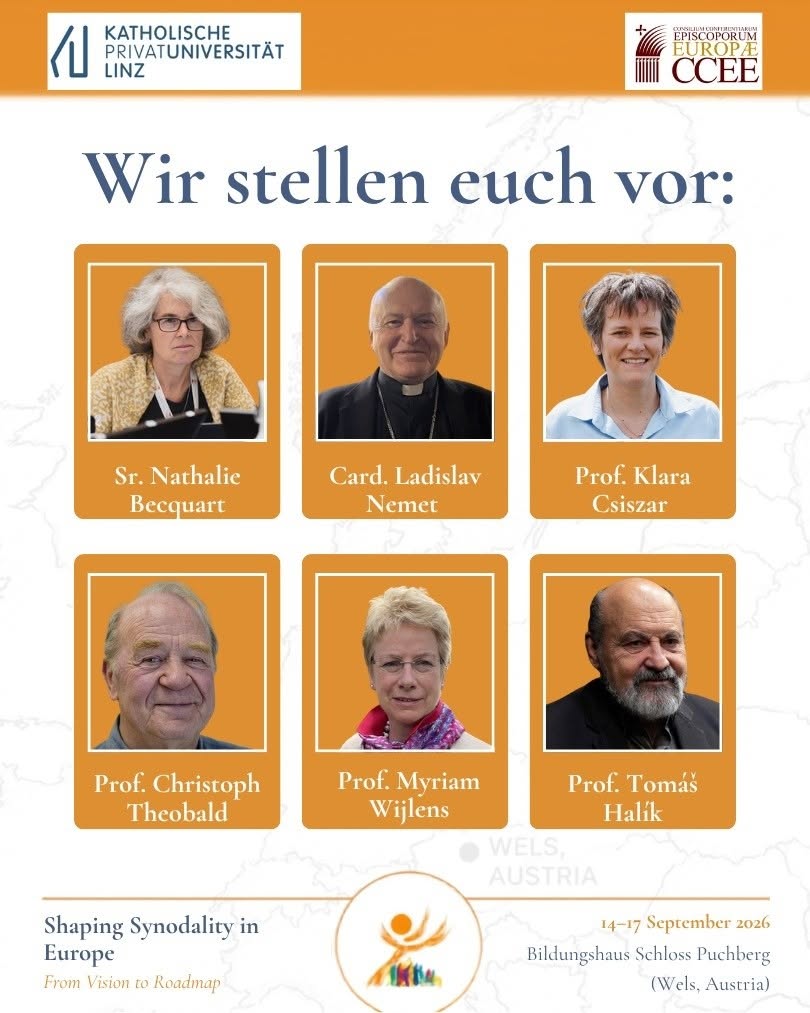
We publish the Post-Communion Meditation of sr Nathalie Becquart, xmcj, Under-Secretary of the General Secretariat of the Synod, pronounced during the Opening Mass (Feast of the Exaltation of the Holy Cross) of the European Symposium on Shaping Synodality in Europe. From Vision to Roadmap, Wels (Austria) 14-17 September 2026.
DOWNLOAD THE PDF IN FRENCH OR ENGLISH.
Wels, 14 September 2026 - We have just received the Body of Christ and, in silence, we welcome this gift of the bread of life that transforms our lives. The liturgy, today, gets it just right: we celebrate the glorious Cross. And this feast illumines the whole meaning of synodality. I would simply like to share with you what this Bread — the gift of Christ's paschal offering — continues to teach me about this path we call synodality. For unity in diversity, missionary communion — the fruit of synodality — is not woven without passing through the cross — but a glorious cross that leads to the Resurrection, to the peace and harmony we long for so deeply, here, in Europe.
In a sense, lived synodality is nothing other than a eucharistic life — a life caught up in the very dynamic of this Eucharist we have just celebrated, through which Christ draws us into his paschal offering. I experience this myself, and I witness it on the ground: living synodality is a path of kenosis. A path of de-centring that passes through the cross. A path of death and resurrection — like a path of migration into a new culture, a path of personal and communal transformation. This is why it is not easy. Discerning together, in a spirit of co-responsibility in the name of our common baptism, in order to bear more fruit in mission, costs something. For it asks us to renounce our own always-limited visions, our egos that so often want to impose themselves on others. It asks us to leave behind competition in order to enter into a dynamic of ecclesial discernment that places the Holy Spirit at the centre and de-centres us all. To walk together with Christ in a synodal style is to take the very path of Christ, who emptied himself, who took the condition of a servant, which is a path of self-lowering, a eucharistic path of offering ourselves for a greater love and service of others. To enter into a synodal process is to let ourselves be transformed by listening to others, by dialogue and conversation in the Spirit, in the search for consensus, listening to the calls of the Spirit.
What I also see is that the further we advance in the synodal experience and in the implementation of the fruits of the synod, the more we discover and better understand what synodality is — something that touches the very mystery of the Church, of which it is a constitutive dimension. From the Synod on Young People until today, synodal stage after synodal stage, gathering after gathering in a synodal style in every corner of the world, I never cease to deepen my understanding of what synodality is, and to contemplate the Spirit at work in the diversity of persons and contexts. One never finishes entering into the mystery of the Church.
We know this: words struggle to render the depth of the synodal experience. It can be written down, documented — but what we live always exceeds what we can say of it. And yet we must keep searching for the words, naming the synodal experience and practice, rereading it theologically and giving an account of it, so as to continue discerning the paths of mission in today's Europe. A Europe that is particularly diverse, and confronted by many challenges and sufferings, marked too by divisions and polarisation, conflicts and wars.
The starting point of synodality is always reality — the reality of each local Church, with its history, its own graces and its wounds. There is not a single synodal path and pace; there are as many as there are peoples whom the Spirit gathers. And the task before all of us is to continue this path of inculturation while strengthening exchanges between Churches, between members of the People of God. We are all still learning. No one walks this path alone — a path which is that of “the exchange of gifts.”
May we enter into this experience of our symposium with our whole being, disposing ourselves with confidence to the work of the Spirit. For a synodal gathering is at once a fully human experience, an ecclesial one, and a spiritual experience. The synodal adventure never ceases to transform us, plunging us ever more deeply into the trinitarian mystery that founds it. And the eucharistic mystery manifests, at its highest point, the eschatological horizon that orients our walking together: the banquet of the Kingdom of heaven that will gather us all in a unity in diversity.
The Final Document (FD §43) says this with a precision I would like to repeat to you:
Synodality is primarily a spiritual disposition. It permeates the daily life of the Baptised as well as every aspect of the Church's mission. A synodal spirituality flows from the action of the Holy Spirit and requires listening to the Word of God, contemplation, silence and conversion of heart. (…) A spirituality of synodality also requires asceticism, humility, patience and a willingness to forgive and be forgiven. It welcomes with gratitude and humility the variety of gifts and tasks distributed by the Holy Spirit for the service of the one Lord (cf. 1 Cor 12:4-5). It does so without ambition, envy or desire for domination or control, cultivating the same attitude as Christ who “emptied himself, taking the form of a slave” (Phil 2:7). We recognise the fruits of a spirituality of synodality when the daily life of the Church is marked by unity and harmony in pluriformity.
— Final Document, §43
Unity in diversity is not manufactured; it is woven and received, at the far end of a passage through the cross. But this passage never opens onto a sealed tomb. It opens onto the Resurrection. Like the grain of wheat that falls to the ground so as not to remain alone and to bear fruit, may we become what we have received, a Body broken and shared, so that in our very diversity we may be signs of that peace and unity so deeply desired by our brothers and sisters in Europe.