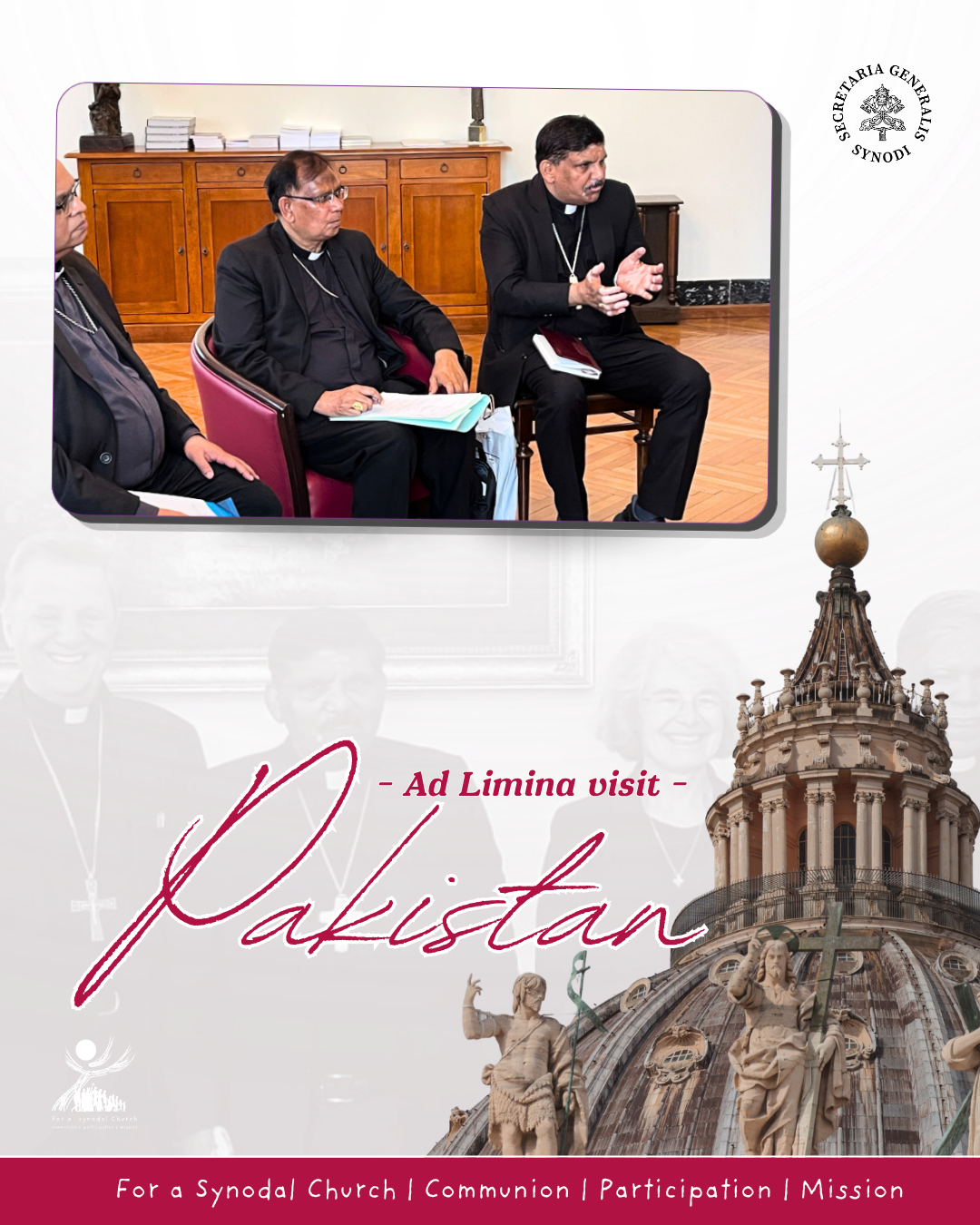
This morning, Cardinal Mario Grech and Sr Nathalie Becquart, XMCJ, met with the bishops of Pakistan on their ad limina visit guided by Mgsr. Samson Shukardin, Bishop of Hyderabad and President of the Bishops' Conference of Pakistan. Then, On behalf of the eight bishops attending the meeting at the General Secretariat of the Synod, His Excellency Bishop Khalid Rehmat OFM Cap, Archbishop of Lahore and member of the XVI General Assembly of the Synod of Bishops, outlined the state of implementation of synodality in the country’s dioceses.
Since the beginning of the process, “all the dioceses of Pakistan wholeheartedly embraced the spirit of Journeying together, carrying out numerous initiatives to integrate the synodal spirit at every level” stated archbishop Rehmat. “This experience of sharing, discussion and listening was rooted in the Scripture and prayer, which made us understand that we are one body, all in the same boat, called to discern the voice of the Holy Spirit in our mission, especially to the peripheries with the hope of bringing renewal to the Church”.
For Lahore’s archbishop, the implementation of synodality has brought about a profound transformation in the pastoral landscape across all the dioceses of Pakistan, starting it from the Clergy and Religious. “This has strengthened the bonds of communion among the clergy, religious and lay faithful, building a participatory Church for the mission. The Journeying together has not been an exclusive experience but an inclusive one. The Clergy and religious in Pakistan welcomed the Synod in a very progressive manner”.
As a result of that, the Clergy and Religious stepped forward to form and transform their parish communities. The parish groups and the Commissions would come together periodically for the discussions with the faithful, different parish groups and volunteers.
Particular attention was paid to the involvement of young people and to dialogue with other Christian denominations and other religions. “Since Christians are a minority in Pakistan, it was enriching to hear from youth their personal experiences that even today despite the challenges and struggles they feel encouraged in their lives”. From an ecumenical perspective, the bishops said that “the entire Pakistani Church engaged with other denominations and main stream churches on sharing the journey of synodality – of being one Church... so that living in a predominantly Muslim milieu in our country we may witness our synodality and journeying together with the Lord. This was made possible by reaching out to others and making them part of synodality”. Finally, with regard to dialogue with Islam, Bishop Rehmat acknowledges that “the synodal journey in all the dioceses of Pakistan was a challenge and an opportunity to witness the spirit of dialogue with the people of other faiths. It was very much appreciated and acted upon among all the dioceses in Pakistan to implement a lived synodality with the leaders in Inter-faith dialogue”.
While the synodal journey has yielded many positive outcomes, the bishops of Pakistan have recognized that it has not been without its many challenges. Given the context of Christians being in a minority, “religious and social pressures have posed significant obstacles. External factors such as religious intolerance, discrimination, and social exclusion have often hindered open participation in certain areas of Pakistan. Additionally, some communities initially found it difficult to understand the meaning and significance of synodality”. Despite this situation, “the Church in Pakistan remains firmly dedicated to deepening the synodal journey. Key aspirations and future actions include integration of synodal practices in the Church with Clergy, Religious, Commissions, parishes, Ecumenism, Inter-religious dialogue, families and youth through consultations, open forums, and collaborative decision-making structures, in shaping a vibrant and responsive Church. Despite ongoing challenges, the steadfast commitment of the faithful to walk together, led by the Holy Spirit, offers a solid foundation for the continued development of a truly synodal Church” concluded Archbishop Rehmat.